
Ambubachi Mela at Kamakhya Temple, Guwahati, Assam
Ambubachi Mela or Ambubasi festival is an annual fair celebrated for four days in Kamakhya temple, Guwahati, Assam during the Assamese month of Aahar (mid-June).
It is believed that the presiding deity of the temple Devi Kamakhya (a form of Shakti) goes through her annual cycle of menstruation during this period. The temple is closed for three days during this period and the doors of the temple open on the fourth day when devotees throng in a long queue to get a glimpse of the goddess..
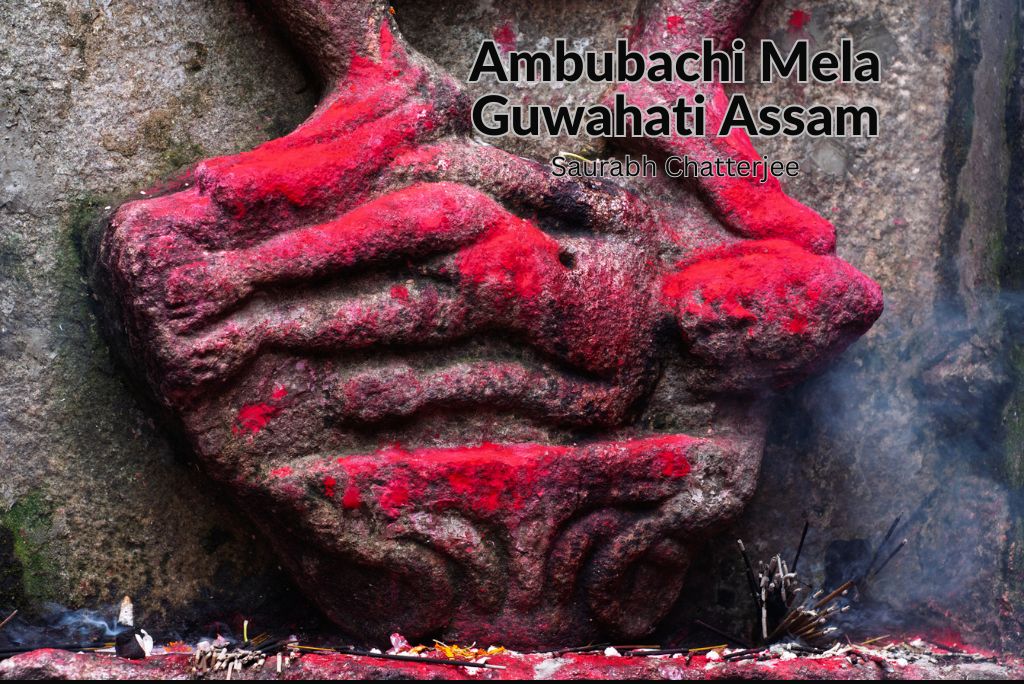
The deity is believed to have been there since prehistoric times. There is no man-made statue of the goddess but a stone of shape similar to the vagina.
My Pictures of People of Ambubachi Mela Kamakhya Assam
See my pictures of Ambubachi Mela Kamakhya Assam in better resolution here .
There are thousands of people who come from all over India, especially West Bengal, Bihar, and Assam to witness this festival and take blessings from the goddess in form of a small bit of cloth which is believe to be wet with the menstrual fluid of Goddess Kamakhya.
It is also one of the 51 Shaktipeeths. According to legend, when Vishnu cut Sati’s body into 51 parts, the vagina fell at this place.
This is a must-do pilgrimage for the tantric cult sadhus.
The temple is situated on top of the Neelanchal hill. There are over-loaded vehicles that take you to the top.
Ambubachi Mela Dates
Ambubachi Mela happens in the Assamese month of Aahar (mid-June).
Since I was a child, my father sent a money order to the priest at Kamakhya temple every year. In return, after about a month, we used to receive a packed with some prasad and a small piece of red cloth. That’s the only thing I knew about the Ambubachi festival. Later as I read more about the place, the more I was determined to see the event.
Attending this festival was in my To-do list since quite some time because of its eccentricity. Last June, I got an opportunity to go to Guwahati for work, right on the time of Kamakhya fair. I’m always very lucky, you know.
I chose to walk up and fortunately, I was not the only one.
Ambubachi Mela Photography Guide: Documenting India's Most Mysterious Festival at Kamakhya Temple
Introduction: Where Faith, Mythology and Photography Meet
Hidden atop the Nilachal Hills overlooking the Brahmaputra River lies one of India's most powerful spiritual sites: the Kamakhya Temple in Guwahati, Assam.
Once every year, this ancient temple becomes the center of one of the most fascinating religious gatherings in India—the Ambubachi Mela.
Unlike most festivals that celebrate joy, harvest, or victory, Ambubachi revolves around a unique belief. It marks the annual menstruation of Goddess Kamakhya, symbolizing fertility, creation, and the cyclical rhythms of nature.
For photographers, Ambubachi Mela offers something rare:
📸 Powerful portraits
📸 Intense human emotions
📸 Ancient rituals
📸 Spirituality in its rawest form
📸 Documentary storytelling opportunities found nowhere else in the world
If approached respectfully and thoughtfully, Ambubachi can become one of the most meaningful photographic experiences in India.
What is Ambubachi Mela?
Ambubachi Mela is an annual Hindu pilgrimage held at the Kamakhya Temple in Assam.
According to local tradition, the goddess undergoes her yearly menstrual cycle during this period. The temple remains closed for three days and reopens on the fourth day when devotees receive blessings and sacred offerings.
Thousands of pilgrims, sadhus, tantrics, monks, and spiritual seekers gather from across India.
The result is a remarkable convergence of faith, devotion, mysticism, and humanity.
Why Ambubachi Mela is Unique
🔥 One of India's Most Unusual Religious Festivals
Unlike many Indian festivals, Ambubachi is centered around:
-
Feminine power
-
Fertility
-
Nature
-
Tantric traditions
This makes it culturally and visually distinct.
🌍 A Gathering of Diverse Spiritual Traditions
You will encounter:
-
Naga Sadhus
-
Aghoris
-
Tantric practitioners
-
Pilgrims
-
Devotees from remote regions
Few festivals bring together such a diverse collection of people.
📖 Extraordinary Documentary Potential
Every corner offers:
-
Portraits
-
Rituals
-
Human interactions
-
Stories of faith
This is a paradise for documentary photographers.
Best Time to Visit Ambubachi Mela
The festival typically takes place during:
📅 June
Dates vary according to the Hindu calendar each year.
It is advisable to arrive at least one day before the temple closes.
This allows time to:
✔ Understand the environment
✔ Scout locations
✔ Build familiarity
What to Expect
Ambubachi Mela is not a tourist event.
It is intense.
You will encounter:
-
Large crowds
-
Long walks
-
Humid weather
-
Deeply personal acts of devotion
At times it may feel overwhelming.
At other times, profoundly moving.
The strongest photographs often emerge in these quieter moments.
Practical Travel Guide
✈️ How to Reach
Nearest Airport:
Lokpriya Gopinath Bordoloi International Airport, Guwahati
The Kamakhya Temple is approximately 20 km from the airport.
🏨 Accommodation
Book accommodation several months in advance.
Good options include:
-
Guwahati city hotels
-
Guesthouses
-
Temple area lodges
Demand increases dramatically during the festival.
🌤 Weather
June in Assam means:
-
High humidity
-
Occasional rain
-
Temperatures around 25–35°C
Carry:
✔ Rain protection
✔ Water
✔ Light clothing
Photography Guide to Ambubachi Mela
This is where things become interesting.
📷 What Should You Photograph?
Most first-time photographers focus only on dramatic-looking sadhus.
This is a mistake.
The festival is much bigger than that.
1. Portraits of Faith
Look beyond appearances.
Focus on:
-
Expressions
-
Gestures
-
Emotion
The strongest portraits often come from genuine human connection.
2. Pilgrims and Devotees
Many people travel hundreds or thousands of kilometers to attend.
Their journeys are stories worth documenting.
3. Rituals and Interactions
Watch how people:
-
Pray
-
Wait
-
Rest
-
Interact
These moments often reveal the deeper meaning of the festival.
4. Environmental Portraits
Include context.
Show:
-
Camps
-
Temple surroundings
-
Other pilgrims
Context transforms portraits into stories.
🎯 Composition Tips
Use Layers
Ambubachi is visually dense.
Look for:
-
Foreground
-
Midground
-
Background
to create depth.
Work Slowly
Observe before photographing.
Many moments reveal themselves with patience.
Tell Stories
Instead of creating individual images, think in terms of:
-
Openers
-
Details
-
Portraits
-
Closing frames
Build visual narratives.
⚙ Recommended Equipment
Essential Lenses
📷 24–70mm
Perfect for general coverage.
📷 70–200mm
Useful for candid moments.
📷 35mm or 50mm Prime
Ideal for storytelling and portraits.
Ethical Photography at Ambubachi
This is perhaps the most important section.
Remember:
You are entering a sacred environment.
Not a photography set.
✔ Do
-
Ask permission whenever possible
-
Respect personal boundaries
-
Engage respectfully
-
Learn before photographing
❌ Don't
-
Intrude during prayer
-
Photograph aggressively
-
Treat people as exotic subjects
-
Chase sensationalism
The best photographs emerge from respect.
Common Mistakes Photographers Make
❌ Photographing Only Sadhus
Many visitors return with hundreds of similar portraits.
The festival is much more than that.
❌ Ignoring the Human Stories
Faith, waiting, devotion, fatigue, celebration.
These are the real stories.
❌ Moving Too Fast
Slow down.
Observe.
Let the festival reveal itself.
Why Ambubachi Mela is a Dream for Documentary Photographers
The festival offers a rare combination of:
🌍 Culture
🙏 Spirituality
👥 Human connection
📖 Storytelling
Few events in India provide such depth.
For photographers interested in long-form documentary work, Ambubachi is one of the most rewarding festivals in the country.
For Serious Photographers
Photographing Ambubachi Mela can be challenging.
Access, timing, local knowledge, and cultural understanding all play a role.
Over the years, I have guided photographers through some of India's most significant festivals and cultural events.
My photography tours are designed for photographers who want to:
✔ Build meaningful stories
✔ Improve their documentary skills
✔ Access authentic experiences
✔ Return with a strong body of work
These are small-group, immersive experiences focused on storytelling rather than sightseeing.
If you are interested in photographing India's most extraordinary festivals, Ambubachi Mela is one of the finest places to begin.
Final Thoughts
Ambubachi Mela is not simply a festival.
It is a window into India's spiritual landscape.
It challenges assumptions.
It rewards patience.
And for photographers willing to engage with it respectfully, it offers images that go far beyond aesthetics.
It offers stories.
Tips for photographers
For Serious Photographers
If you’re planning a photography journey to India, timing is one of the biggest challenges.
The difference between:
- Average images
and - Strong, meaningful work
often comes down to:
👉 Being in the right place at the right time
Over the years, I’ve worked extensively across India, designing photography experiences around:
- Light
- Culture
- Access
- Timing
The photography tours I offer are:
- Small group
- Carefully timed
- Built for storytelling
These are not standard tours.
They are designed for photographers who want to:
✔ Capture India at the right moment
✔ Access meaningful locations
✔ Build a strong portfolio
👉 You can explore upcoming India photography tours or get in touch to plan your journey.
Note: If you want a customized tour anywhere in India focused on Photography, I will be happy to organise it for you.
About the pictures
An old lady taking rest on the way. As I gained height, I got better views of the city
I met many sadhus on the way. Many of them were from West Bengal.
Drinking is a part of the Tantrik cult practices. I saw people drinking on the roads. I took a quick shot.
There were many temporary taps set up by the government for the convenience of the pilgrims. Most of them cannot afford to stay in hotels and sleep in the open.
As I started approaching the temple, it got crowded. There were many shops on the way, temporarily set up for the fair. Since the temple was opening after 3 days, there was a huge rush to see take a glimpse of the god.
This foreigner sadhu was caressing his pigeon before leaving it at the temple.
The crowd was huge and sometimes people got unconscious. The Bharat Scout and Guides volunteers were doing an excellent job to provide a support system.
This lady was getting her kids ready, they will then go around the temple asking for donation for their miniature god.
One very interesting practice I saw here was offering pigeons to the goddess. There were many devotees who bought pigeons and placed them on the temple walls after offering their prayers.
I came across many sadhvis (female sadhus) with long matted hair. People apply vermilion on the statues, especially on the vaginal parts. Animal sacrifices are common in this temple. The sadhu is caressing his goat before the act. Its a practice for all married women to apply sindoor (vermilion) to each other after the pooja.
Media was there trying to show the hardships of the people. People were in queue standing for hours and some were saying that there is no proper crowd management. I found it to be absolutely fine in such a huge volume of crowd.
This is the temple tank where people take bath before going to the temple.
Standing in the same place since midnight of the last day, these people were really upset. There were other people who got into the queue just because they paid a priest of the temple. Unfortunately, like most temples in India, the ministers and police officials are given preference, while the common people just keep waiting. Fortunately, I was able to make them smile, for a moment at least.
There are many who sell exotic plant produce during the mela. These are sought after, by the sadhus and devotees. Here, the seller was taking out the rudraksha’s from the fruit.
The volunteers taking a break and having fun.
As the demand for pigeon was more, so was the supply. Some sellers were carrying basket-full of the bird for sale to be offered in the temple.
Thanksgiving
Thanks to all the participants who joined for my previous photography tours.All rights reserved. No copying without permission of the author Saurabh Chatterjee